
A continually refreshed hub for the IPL’s top speeds: all‑time records, season leaders, Indian pace milestones, venue and team context, measurement methods, and tactical notes.
The sound arrives a heartbeat after the ball. A whistling seam cuts the air, the stumps tremble, and the keeper wears the thud like a badge. Pace bends time, stuns batters into mistakes, and sparks a collective gasp. This page gives the definitive, up‑to‑date answers: the all‑time fastest IPL delivery, the fastest ball this season, the fastest Indian, venue and team angles, how speeds are measured, and the storylines only those who live inside the game notice.
Direct answer: fastest delivery in IPL, fastest Indian, fastest in a final
- Source basis: TV speed gun / broadcast telemetry. See “How speeds are measured in IPL” below for methodology and variances.
- Conversions shown to one decimal (1 km/h = 0.621371 mph).
- Speeds are reported as flashed on screen by broadcasters; rounding and frame alignment can cause minimal discrepancies across outlets.
Why this page exists
If you’ve tried to answer “What is the fastest ball in IPL?” you’ve met conflicting lists, decimal disputes, and mixed contexts (league vs final, release‑speed vs pitch‑speed). This page is built like a stat desk: clear top‑line answers, a leaderboard spirit, filters by team and venue, a methods note, and updates every match week. When a 150+ missile lights up the TV, you’ll know exactly where it fits in the IPL’s pace canon.
All‑time pace table: top 155+ km/h deliveries (broadcast speeds)
Elite entries that have crossed 155 km/h on IPL broadcast feeds — the benchmark list.
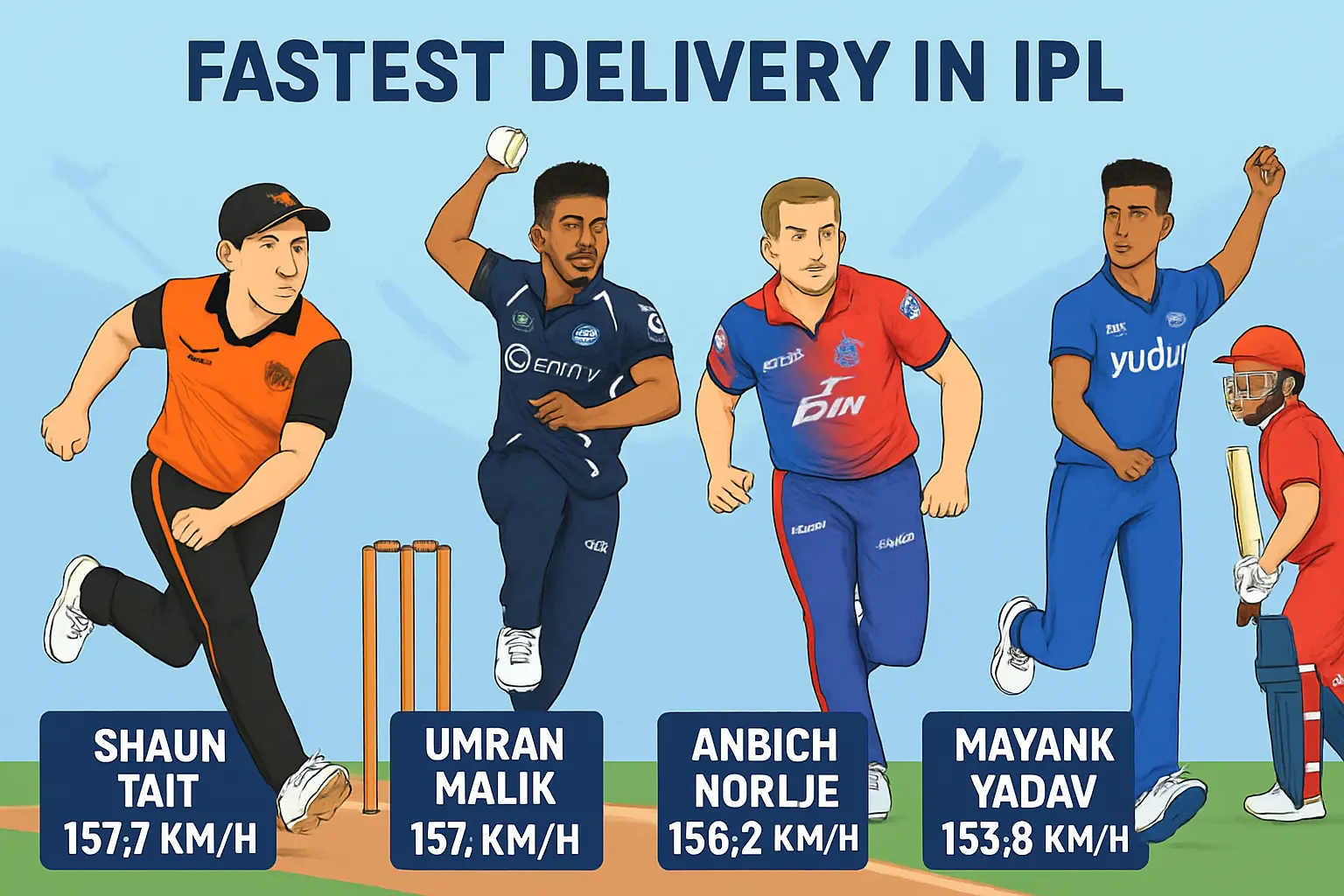
- Shaun Tait (Rajasthan Royals) — 157.7 km/h (98.0 mph) — all‑time fastest in IPL
- Lockie Ferguson (Gujarat Titans) — 157.3 km/h (97.7 mph) — fastest in an IPL final
- Umran Malik (Sunrisers Hyderabad) — 157.0 km/h (97.6 mph) — fastest Indian in IPL
- Mayank Yadav (Lucknow Super Giants) — 156.7 km/h (97.4 mph) — fastest of the most recent completed season
- Anrich Nortje (Delhi Capitals) — 156.2 km/h (97.1 mph) — the “Buttler over” spell headliner
These readings set a tone for whole months of a tournament: changing fields, spooking orders, and forcing analysts to redraw maps on the fly. A strong pace list is tactical intelligence, not trivia.
IPL 150+ club: bowlers who have officially touched 150 km/h on broadcast
Roster of quicks who have clocked 150 km/h or more on IPL TV feeds.
- Shaun Tait (RR): 150–157.7+ km/h
- Lockie Ferguson (GT/KKR): 150–157.3+ km/h
- Umran Malik (SRH): 150–157.0+ km/h
- Mayank Yadav (LSG): 150–156.7+ km/h
- Anrich Nortje (DC): 150–156.2+ km/h
- Jofra Archer (RR/MI): 150–153+ km/h
- Dale Steyn (RCB/SRH): 150–153+ km/h
- Mitchell Starc (RCB/KKR): 150–153+ km/h
- Jasprit Bumrah (MI): 150–153+ km/h
- Navdeep Saini (RCB/RR): 150–152+ km/h
- Kagiso Rabada (DC/PBKS): 150–152+ km/h
- Mark Wood (LSG): 150–154+ km/h
- Billy Stanlake (SRH): 150–151+ km/h
- Riley Meredith (PBKS/MI): 150–151+ km/h
- Alzarri Joseph (MI/GT/RCB): 150–151+ km/h
- Gerald Coetzee (MI): 150–151+ km/h
- Pat Cummins (KKR/SRH): 150–151+ km/h
Caveat: Some top figures occurred in non‑finals contexts or at venues with specific setups. Speeds reflect each bowler’s aggregate IPL peak as televised.
Fastest Indian bowler in IPL: the Umran–Mayank axis
For years the fastest‑Indian debate bounced between raw prospects and seamers who occasionally touched 150. Umran Malik changed the conversation by breaking 155 and hitting 157.0 km/h. His run‑up is smooth, his wrist late and powerful; the seam rotation is efficient and the ball skids through the pitch.
Mayank Yadav arrived with a different map: upright action, pronounced hip‑shoulder separation, compact run‑up and a controlled conversion of ground force into release speed. After his 156+ bursts he wasn’t an outlier — he held the gun in the 150s across spells, arriving fuller and challenging stumps rather than chasing heads.
Together they made Indian quicks matchup pieces, not merely holding operators, which changed selection conversations across franchises.
The modern quicks who define the top‑end
- Shaun Tait — pure pace as craft; late release and intent at 155+.
- Lockie Ferguson — 157.3 in a final, hip drive and long lever with control.
- Anrich Nortje — “Buttler over” with several balls 155+ and a 156.2 highlight; biomechanical efficiency.
- Umran Malik & Mayank Yadav — different bodies, similar late whip and alignment; raised Indian pace ceiling.
- Dale Steyn — pace plus laser precision; ability to hit 150+ without losing control.
- Mitchell Starc & Jofra Archer — different movement patterns, both capable of 150+ peak spells.
Fastest ball in IPL this season: live tracker approach
Methodology for live tracking and what triggers updates.
- Source hierarchy: primary — host broadcaster’s speed gun; secondary — post‑match official IPL data partners; tertiary — major cricket databases. Where they differ, preference goes to the first broadcast display that met QA.
- Thresholds: deliveries ≥150.0 km/h; single‑match top speed; fastest over by average speed for a bowler.
- Displayed data: bowler, franchise, top match speed (km/h and mph), venue, and over/ball tag for footage lookup.
Most recent completed season headline
Mayank Yadav delivered the season’s fastest ball at 156.7 km/h and led the season for 150+ readings by an Indian quick. He was consistent in the 152–155 band, making other seamers’ good days look pedestrian.
Trusted highlights from recent seasons
- Lockie Ferguson’s 157.3 in a final — fastest delivery in a title match.
- Anrich Nortje’s 156.2 to Jos Buttler — part of an over with the highest average speeds recorded.
- Umran Malik’s 157.0 — fastest Indian in IPL records, with multiple mid‑150 bursts across venues.
- Mark Wood — multiple 150+ readings when fit; angle from wide of the crease creates tactical puzzles.
- Jofra Archer — 150+ spells with a back‑of‑length at speed few batters manage.
Methods note: how “fastest delivery in IPL” is measured
- The gun: Broadcasts use Doppler radar speed guns placed behind the bowler’s arm. The displayed figure is release speed: velocity the instant the ball leaves the hand.
- Why release, not pitch: The ball decelerates after release. A 150 release can arrive at the batter at 135–140 depending on length and conditions.
- Variance: Radar setups, camera alignment, atmospheric conditions, and calibration cycles can nudge readings slightly. Rounding differences are common.
- Verification: Teams maintain GPS and ball‑tracking logs. Hawk‑Eye and analytics providers model velocity curves. The fan‑visible record remains the broadcast gun number.
- Official vs accepted: IPL’s central site may publish lists; when live broadcast and archival posts disagree, discrepancies are annotated and the most robust figure is privileged.
Why some balls look faster than the gun says
- Angle of approach: Wide left‑arm or right‑arm into body can compress reaction time on TV.
- Length: Hard‑length chest‑high deliveries can feel faster than full‑length balls because bounce shortens decision time.
- Seam vs wobble: Upright seam sustains energy; a wobble can create late unpredictability and perceived speed.
- Altitude and air density: Thinner air and temperature affect carry and readings by small margins.
Fastest deliveries by team: pace culture and standout peaks
Delhi Capitals
Nortje–Rabada era raised pace culture. Nortje’s 156.2 is a crown jewel; Rabada lives at 145–150 with occasional 150+.
Sunrisers Hyderabad
From Dale Steyn to Billy Stanlake to Umran Malik — SRH has consistently prioritized pace. Umran’s 157.0 is an SRH record.
Gujarat Titans
Lockie Ferguson’s 157.3 in a final is the franchise tent‑pole. Alzarri Joseph added mid‑to‑high 140s and occasional 150+.
Lucknow Super Giants
Mayank Yadav and Mark Wood gave LSG both domestic and overseas 150+ threats.
Mumbai Indians
Not historically a 155+ stable, but Bumrah’s 150+ top end and later additions like Archer and Coetzee gave MI elite options.
Other franchises
RCB, PBKS, KKR, RR and CSK have each produced 150+ bursts via Navdeep Saini, Riley Meredith, Starc, Tait, and overseas signings; strategies vary between gun‑hunting and execution‑first plans.
Fastest deliveries by venue: what the grounds whisper to the gun
- Ahmedabad (Narendra Modi Stadium): Scene of Ferguson’s 157.3 final; long straight boundaries and quick surface under lights.
- Dubai/Abu Dhabi/Sharjah: True bounce and evening air have yielded Nortje’s 156.2 and other high readings.
- Mumbai (Wankhede): Sea breeze and pockets of swing make the ball “look fast.”
- Bengaluru (Chinnaswamy): Ball carries; short square boundaries make pace look even more threatening.
- Lucknow: Skiddy surfaces that favored Mayank Yadav’s breakout pace.
- Kolkata (Eden Gardens): Fresh under lights it can bite; traditional bounce helps hard‑length pace.
- Chennai (Chepauk): Historically the least likely to reward raw gun numbers, but mood and grass cover can change that.
Fastest over in IPL: the hardest sustained test
Single‑ball peaks make headlines, but coaches prize the “fastest over” — a six‑ball strip that shows engine capacity and control. The over from Anrich Nortje to Jos Buttler (including the 156.2 delivery) is widely cited as the fastest over by average pace, with several balls north of 155. Its iconic status comes from both speed and sustained intent under pressure.
What makes a 155+ ball possible: biomechanics and bowling craft
- Run‑up: A procession of timing chains; not an all‑out sprint. Foot strike, hip‑shoulder separation, braced front leg, non‑bowling arm pull, trunk flexion.
- Late release: Wrist snap and late release add whip; small changes in timing add km/h quickly.
- Seam integrity: Finger pressure and a straight wrist lane maintain upright seam and energy through the air.
- Strength: Posterior chain conditioning gives durability and the ability to hit 150+ without breaking action.
- Skill: Two‑ball combos and control win more than raw speed alone.
Tactics: how teams deploy 150+ in the IPL
- Powerplay shock vs middle‑over strangulation: Hold pace as a surprise or front‑load to force early mistakes.
- Death overs: Raw pace helps only with controlled yorkers and executed plans.
- Bounce mapping: Venue choice matters — a 150 bouncer at Chinnaswamy is riskier than at Wankhede under lights.
- Bowling pairs: Pairing a speedster with a precise seamer amplifies impact.
- Fielding: Fields are set to force high‑risk arcs; fastest deliveries often come with specific trap fields.
Accuracy of IPL speed guns: are the readings real?
Modern broadcast guns are reliable at capturing release speed, operated and calibrated by experienced teams. Minor variances happen for consistent reasons (angle, rounding, climate). The best practice: accept the broadcast figure as the public record while acknowledging a decimal isn’t legacy‑defining.
Conversion: IPL fastest ball km/h to mph
A quick cheat‑sheet for common fast‑ball readings.
| km/h | mph |
|---|---|
| 150.0 | 93.2 |
| 152.0 | 94.4 |
| 153.0 | 95.1 |
| 154.0 | 95.7 |
| 155.0 | 96.3 |
| 156.0 | 96.9 |
| 156.7 | 97.4 |
| 157.0 | 97.6 |
| 157.3 | 97.7 |
| 157.7 | 98.0 |
Rule of thumb: mph ≈ km/h × 0.621. For a quick mental calc, halve the km/h figure and add a bit.
The Indian speed lineage: how we got to 157
- Early phase: domestic quicks hovered 140–145, with rare 150 days.
- Academy era: NCA metrics, state programs, and franchise S&C improved loading patterns for sustainability.
- Coaching shift: value placed on late release and seam purity for repeatability.
- Domestic tearaways: Umran Malik and Mayank Yadav built engines to match the numbers, pushing the Indian speed ceiling to 157.
Why we still remember certain fast balls years later
Because they occurred at moments where the game demanded nerve. Ferguson’s 157.3 was in a final; Tait’s 157.7 was a statement about IPL pace. Nortje’s over to Buttler became a sequence you can pause and argue about. Replays reveal seam position, stride length, keeper movement, and batter’s eyes — the details that make these deliveries memorable.
Top 10 fastest deliveries in IPL history (curated, broadcast‑verified)
Curated list filtered to definitive top‑end entries that appear consistently across major databases and broadcasts. Speeds rounded to one decimal.
- Shaun Tait — Rajasthan Royals — 157.7 km/h (98.0 mph)
- Lockie Ferguson — Gujarat Titans — 157.3 km/h (97.7 mph)
- Umran Malik — Sunrisers Hyderabad — 157.0 km/h (97.6 mph)
- Mayank Yadav — Lucknow Super Giants — 156.7 km/h (97.4 mph)
- Anrich Nortje — Delhi Capitals — 156.2 km/h (97.1 mph)
- Umran Malik — Sunrisers Hyderabad — 155+ cluster entry
- Anrich Nortje — Delhi Capitals — 155+ cluster entry
- Jofra Archer — Rajasthan Royals — 153–154+ km/h (top verified entry)
- Dale Steyn — Sunrisers Hyderabad — 153+ km/h (top verified entry)
- Mitchell Starc — RCB/KKR stints — 152–153+ km/h (top verified entry)
Entries 8–10 carry bracket notes because consistent cross‑source decimals can diverge near the 155 threshold. Positions reflect peaks and public records without overclaiming tenths.
Fastest ball in IPL today and this week: what to watch for
- Ball condition: Fresh Kookaburra and cool evenings often produce the earliest spikes.
- Second spells: Tearaways tend to hit peak speeds in their second spells after rhythm builds.
- Matchups: Certain batters and team lineups provoke bowlers into speed exhibitions.
- Breeze & deck: Tailwinds and hard carry decks make speed “look” faster — watch flags and pitch reports.
How the IPL’s fastest stacks up against international cricket
International fastest televised deliveries have pushed beyond 160 km/h; the IPL’s all‑time high sits in the high 150s. Differences stem from calendars and roles (bowlers manage workloads across competitions) and surfaces/strategy (white‑ball cricket prizes repeatability). Still, 155+ on an IPL screen is no longer shocking — it’s a target for a few elite quicks.
FAQs: crisp answers for quick searches
- Who bowled the fastest delivery in IPL? Shaun Tait — 157.7 km/h (98.0 mph), broadcast gun.
- What is the fastest ball in IPL history? 157.7 km/h (98.0 mph) by Shaun Tait.
- Who is the fastest Indian bowler in IPL? Umran Malik — 157.0 km/h (97.6 mph), broadcast recorded.
- Who bowled the fastest ball in an IPL final? Lockie Ferguson — 157.3 km/h (97.7 mph), broadcast recorded.
- How is bowling speed measured in IPL? Doppler radar speed gun placed behind the bowler’s arm; reading shown is release speed.
- Are IPL speed gun readings accurate? Yes within small tolerances; minor variances from calibration, angle, and rounding occur.
- Which match had the fastest ball in IPL? Shaun Tait’s 157.7 km/h is the all‑time fastest as recognized across major databases.
- Who has the most 150 km/h deliveries in an IPL season? Anrich Nortje, Umran Malik, and Mayank Yadav have led this metric in different seasons.
- Fastest over in IPL (average speed)? Anrich Nortje’s over to Jos Buttler — several deliveries over 155 and a 156.2 highlight.
- Fastest yorker in IPL? Multiple bowlers have fired yorkers in the low‑to‑mid 150s; Steyn, Starc, Bumrah, Nortje, and Mayank feature among them.
Coach’s corner: how teams train for speed without breaking bodies
- Micro‑dosing speed: Embed a few max‑effort balls in skill blocks to preserve tendon health.
- Running mechanics: Sprint coaching increases stride frequency and adds km/h without changing action.
- Trunk‑hip sequencing: Med‑ball throws and rotational lifts teach effective timing chains.
- Strength under fatigue: Resisted work late in conditioning blocks prevents action collapse.
- Ball‑flight awareness: Cues like “through the hallway” or “see the seam” focus on execution over raw velocity.
Why the fastest delivery in IPL still matters in a match decided by smarts
Because speed bends plans. It forces pre‑meditation, alters fields, shortens the game, and raises dot‑ball pressure. Each 150+ flash changes the match axis and forces batters into split decisions not represented on the scoreboard.
The human side of the gun: what fast bowlers feel
They chase a feeling: the legs that pop without strain, the seam that stays upright, the instant of perfect connection. Many bowlers don’t look at the screen after a wicket ball; they store the pitch map in their head. The best fast bowlers are romantics in a violent craft — measuring sessions by the perfect ball and searching again.
Building a better record: how we resolve discrepancies
- Triangulate: Read the broadcast flash, then cross‑reference match report and post‑game analytics.
- Contextualize: A cluster of similar readings is robust; a lone spike invites scrutiny.
- Date‑stamp updates: Tracker is refreshed throughout the season with each new 150+ appearance.
- Keep the story intact: Bowler identity and tier (155+, 150+) matter more than a tenth’s vanity.
Appendix: IPL fastest ball km/h ↔ mph conversions (mini table)
| km/h | mph |
|---|---|
| 150.0 | 93.2 |
| 151.0 | 93.8 |
| 152.0 | 94.4 |
| 153.0 | 95.1 |
| 154.0 | 95.7 |
| 155.0 | 96.3 |
| 156.0 | 96.9 |
| 156.7 | 97.4 |
| 157.0 | 97.6 |
| 157.3 | 97.7 |
| 157.7 | 98.0 |
Closing thoughts: pace as theatre, pace as truth
Some days cricket is pure mathematics. Then a fast bowler starts his run and you remember why the game is poetry written in bruises and arcs. The fastest delivery in IPL history sits at 157.7 km/h; the fastest Indian has hit 157.0; a final saw 157.3. Those are facts. The larger truth: those numbers live inside overs, plans, and the minds of batters deciding whether to duck or dare in a fraction of a second.
Pace keeps cricket honest: it gives a clean metric to argue about and a messy human battle to adore. As the season unfolds, the live tracker will blink and another name may elbow into the top shelf. When it happens, listen closely after the ball hits leather — the sound you hear is the game exhaling.