
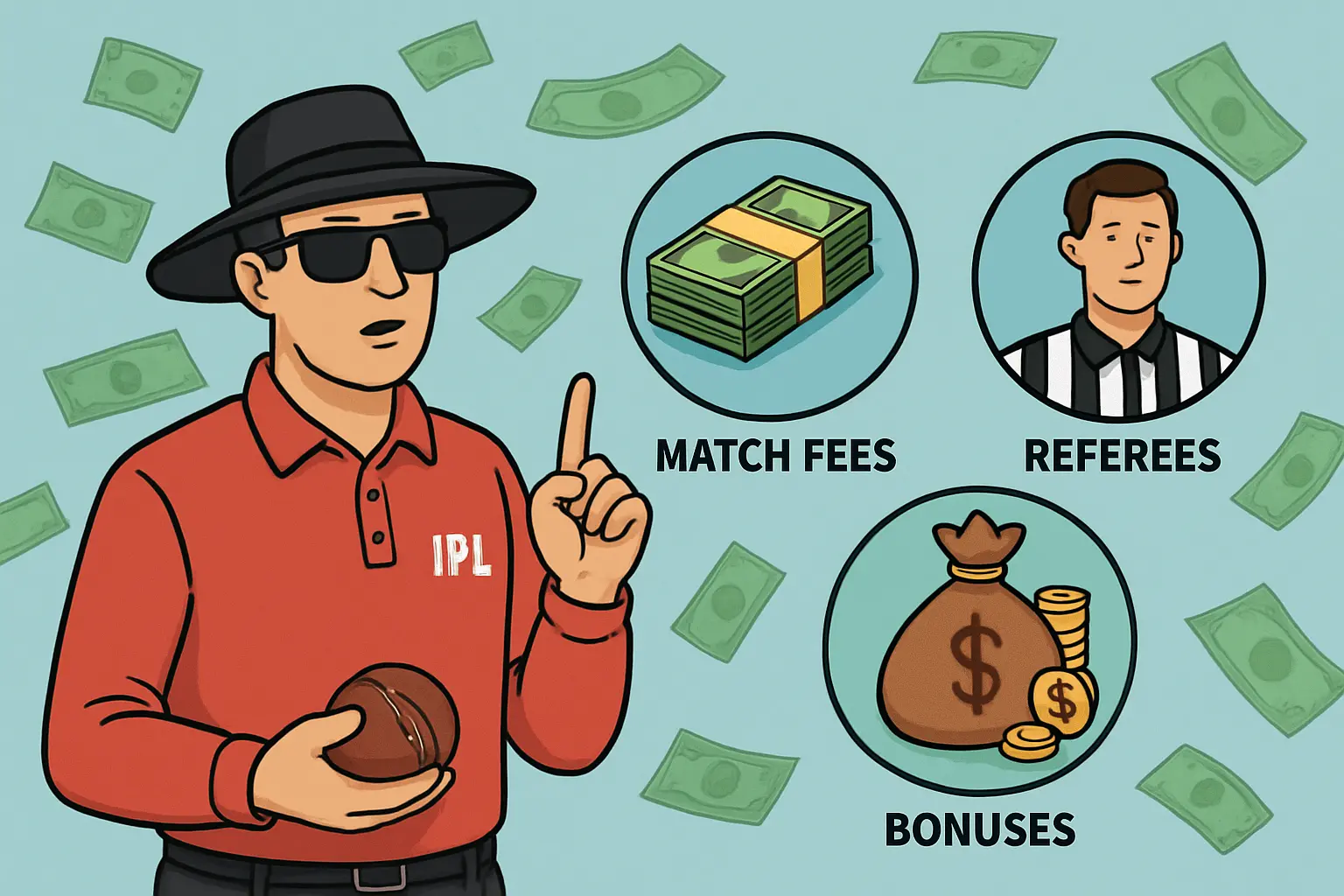
The Indian Premier League treats officiating like a high-performance craft. The pressure is relentless, the spotlight unforgiving, and the workload more complex than most fans realize. With broadcast innovations, real-time officiating systems, and a congested schedule spread across multiple cities, umpiring in this tournament is a specialized job with a compensation structure that reflects the scale and tempo of the league.
Here is the plain-language snapshot many readers want first, followed by the deep dive.
- On-field umpire salary IPL: senior panel officials are paid a high per-match fee, with a lower band for developing domestic umpires.
- TV and third umpire salary IPL: typically aligned with on-field rates for that assignment.
- Reserve umpire salary IPL: paid a smaller per-match fee and the same allowances while on tour duty.
- IPL match referee salary: broadly comparable to senior umpire rates, often at the upper end of the range.
- Playoffs and final: added match premiums and end-of-season bonuses.
- Daily allowance and travel: per-diems, business-class travel on long hauls, and full accommodation are covered by the board.
- Retainers: small seasonal retainers for domestic umpires, higher for seasoned or ICC Elite Panel officials when contracted.
No single public document lists every rupee because the board does not officially publish detailed officiating contracts. However, the ranges below are consistent with figures circulated in reputable Indian sports media, interviews with match officials, and historical rates adjusted for inflation and scale. Think of them as realistic benchmarks rather than a rigid rate card.
How IPL umpire salary is structured
Pay for match officials in the league is built on four pillars.
- Per-match fees
- Playoff and final premiums
- Seasonal retainers
- Allowances, travel, and accommodation
The per-match fee is the engine. Everything else sits around it, nudging season earnings up or down based on the number of appointments and whether those assignments include playoffs.
IPL umpire salary per match
Per-match remuneration is banded by experience and panel status. The tournament blends top Indian umpires from the BCCI’s Elite and Development panels with select ICC Elite Panel names who rotate through the season.
- Senior on-field umpire match fee: generally sits in a high six-figure band in rupees per game. This figure is what media often headline when they say IPL umpires earn a little under two lakh per match.
- Development or domestic on-field umpire match fee: a clear tier below the senior band, typically in the mid five-figure to low six-figure range per match.
- TV and third umpire match fee: most appointments apply the same band as the on-field assignment for that official. Equality here recognizes that a third umpire may make more consequential decisions across DRS referrals, line calls, and no-balls than anyone else on the crew.
- Reserve umpire fee: a smaller per-match fee reflective of standby duties. Reserve officials must attend match briefings, be fully kitted, and are subject to immediate elevation if an on-field or TV umpire goes down late or becomes unavailable.
Estimated ranges, expressed in rupees, that are commonly reported across seasons:
- Senior or Elite Panel on-field or TV umpire: approximately 1.6 lakh to 2.0 lakh per match
- Domestic or Development on-field or TV umpire: approximately 50,000 to 1.0 lakh per match
- Reserve umpire: approximately 30,000 to 70,000 per match
These bands fluctuate slightly by season and assignment mix. Across a league phase where an official might work a dozen or more games, the per-match structure becomes the primary determinant of earnings.
TV and third umpire salary IPL and reserve umpire fees
The third umpire is the nerve center. From tight stumping decisions to ultra-fine edges picked up by UltraEdge, the booth is where momentum-shifting calls are shaped in seconds in concert with Hawk-Eye operators and the broadcast director. The workload can be more stressful than being square-leg on a quiet evening.
For that reason, most seasons have treated TV and third umpire pay on par with on-field assignments within the same panel tier. If a senior official is scheduled into the booth, the fee mirrors the senior on-field rate. If a development umpire is assigned TV responsibilities, the fee aligns with the development band.
Reserve duty is different. The reserve umpire attends all briefings, completes ground inspections if asked, assists with pre-game protocols, and takes over if needed. The fee is smaller than an on-field or TV slot but includes travel and allowances identical to the rest of the crew. Practically, a reserve official on an extended road swing still accrues a meaningful stipend across games even without stepping onto the turf.
Match referee salary in IPL
The match referee is the custodian of the playing conditions, the Code of Conduct, and all administrative guidelines. This role coordinates with team managers, head coaches, captains, and the umpiring crew before, during, and after each match. Every code breach, from slow over rates to player dissent, flows through the referee’s desk.
Media reports and conversations with long-serving officials place match referee pay close to or slightly above senior umpire bands on a per-match basis. A realistic bracket is 1.6 lakh to 2.5 lakh rupees per match. Referees are typically drawn from the BCCI’s Elite Match Referee panel or, in some seasons, from the ICC pool. In terms of time on task, referees can spend longer in post-match adjudication than umpires, especially during busy weeks when multiple disciplinary notes land within hours of the final ball.
Playoffs vs league stage earnings
Postseason games are paid at a premium. There are two layers to this uplift.
- A higher per-match fee for playoff appointments
- A one-off premium for the final, sometimes labeled as a bonus in board communication
The exact uplift varies by season. A conservative description that matches patterns seen in the league is a playoff premium on top of the base per-match fee for that panel, and an additional increment for the final. For a senior official, that could push a single playoff game well above the two lakh mark, with the title match higher still. Development-panel officials who make the playoffs benefit similarly, with smaller absolute numbers but the same structure.
Because playoff berths are limited and appointment balance matters, officials often measure their seasons in two ways: total matches across the league phase and whether they were trusted with the business end. A final assignment is both an economic bump and a career milestone that tends to inform future panels and international opportunities.
Allowances, travel, and accommodation
The daily life of an IPL umpire resembles that of a touring player. Early flights, odd check-in times, evening starts, late meals, and relentless city-to-city movement. Compensation acknowledges that grind.
- Daily allowance: a per-diem in the range of ten to twelve thousand rupees has been typical, varying marginally by city and board directives. The allowance covers incidentals and meals outside team hotel provisions.
- Travel: economy on short domestic hops, with business class used on longer hauls where policy permits. International officials flying in and out receive premium economy or business depending on contracts.
- Accommodation: five-star hotels are standard across host cities, centrally booked by the league.
- Local transport: dedicated cars or official shuttles aligned with team logistics.
- Laundry and incidentals: reimbursed under a cap, or folded into per-diem rules depending on city.
During bio-secure periods in past seasons, separate allowances covered testing and isolation-related logistics. While strict bubbles are no longer the norm, the league retained the practice of front-loading logistics planning and keeping allowances in line with a premium professional environment.
Season retainers and bonuses
Per-match pay does most of the heavy lifting. Even so, officials often receive seasonal retainers.
- Development-panel retainer: a modest fixed payment for being on the panel, completing preseason workshops, and keeping availability open across the window
- Senior/ICC retainer: a larger fixed payment reflecting stature and probable match load
Some seasons include small end-of-competition bonuses for flawless availability or perfect compliance records. Individual awards at the league’s end-of-season ceremony are honorary rather than cash heavy, but a Referee or Umpire of the Season plaque does influence subsequent appointment profiles and, in turn, future earnings.
Sample earning scenarios for an IPL umpire
Figures below are indicative to help readers understand how the moving parts add up.
Scenario A: Senior on-field or TV official
- League phase: 12 matches at approximately 1.8 lakh per match
- Playoffs: 2 matches at a premium rate crossing 2.0 lakh per match
- Retainer: moderate senior retainer
- Allowances: daily per-diem across roughly six weeks plus travel, accommodation
A typical season in this scenario reaches the mid-to-high twenties in lakh rupees purely in match fees, with total value higher once allowances and retainer are included.
Scenario B: Development-panel official
- League phase: 10 matches at approximately 70,000 per match
- Playoffs: none
- Retainer: smaller domestic retainer
- Allowances: identical hotel and travel treatment, same per-diem
Seasonal match fees settle in the mid single-digit lakhs to low double digits, with total value depending on actual appointment count.
Scenario C: Match referee with playoff duties
- League phase: 11 matches around the senior band
- Playoffs: 2 matches at a premium, including the final
- Retainer and allowances: as per referee policy
Match fees alone comfortably cross the mid twenties in lakh rupees; the final tips the number higher. Referees with heavier schedules and consistent playoff duty eclipse that range.
How umpire panels are selected
Selection blends performance data with availability and health. The BCCI’s umpiring department maintains a rolling matrix on every official covering:
- Accuracy rates on key decision categories, including LBW, caught behind, short runs, no-balls, and boundary calls
- Third umpire metrics such as time to decision and reversal rates
- Fitness benchmarks from preseason testing
- Player and coach feedback logs compiled by match referees
- Discipline and punctuality indicators
Appointments are then mapped against the league schedule with an eye to fairness, click-wise travel patterns, and ground familiarity. A given umpire will not officiate the same franchise repeatedly in quick succession without counterbalancing assignments elsewhere. For playoffs, the shortlist tilts toward officials with the highest accuracy metrics and strongest recent match control. The process is data-heavy but also human: conversations with referees and the umpires’ manager influence close calls.
Who typically fills these slots
- Indian stalwarts such as Nitin Menon, Anil Chaudhary, KN Ananthapadmanabhan, and Sundaram Ravi have become familiar faces
- Overseas officials on the ICC Elite Panel rotate into marquee games when scheduling allows
- Development-panel names graduated out of strong domestic seasons, particularly those who navigated high-pressure T20 knockout games without a blemish
What the third umpire actually does in an IPL match
The TV booth is a control room. The third umpire juggles multiple feeds, ball-tracking data, and audio tools while feeding concise instructions to the broadcast director and on-field umpires.
- DRS operations: uses Hawk-Eye for ball-tracking, UltraEdge or Snickometer for the faintest of edges, and synchronized frame analysis to check grounded catches
- Front-foot no-balls: monitors a live feed dedicated to the popping crease as policy prescribes
- Run-outs and stumpings: frame-by-frame checks for bat status, line lighting, and bail separation
- Boundary reviews: determines whether a fielder has brushed or leaned on the boundary cushion
- Time policing: alerts the crew about slow-over-rate risks
The pace can be frantic during a tight chase. A third umpire can process a half-dozen decisions in a single over while maintaining communication discipline. This is why fee parity with on-field slots is justified and widely accepted among officials.
Why IPL umpire salary looks the way it does
Three forces have shaped the modern pay scale.
- Broadcast value and pace: IPL is a television product with billions of eyeballs and advertisers tracking every second. Officiating decisions must be both quick and defensible. Pay recognizes that the league demands elite decision-making speed.
- Technology depth: the league’s reliance on Hawk-Eye, synchronized feeds, and specialized replay rooms makes the job a hybrid of fieldcraft and systems thinking. Officials are trained in back-end operations, not just Laws and playing conditions.
- Availability costs: officials commit an entire window to the league, with travel, media commitments, and little downtime. A significant per-match fee offsets the professional opportunity cost for those who also stand in domestic and international cricket.
Comparative context matters. In other T20 leagues, pay is solid but rarely touches the IPL ceiling. In international cricket, ICC retainers and daily allowances are strong for the elite group, yet the sheer density of IPL games over a short window lets match fees compound quickly.
IPL umpire salary vs PSL, BBL, The Hundred, SA20, and CPL
Comparisons across leagues are imperfect because boards pay in different currencies and handle travel differently. Conversions move season to season. That said, a consistent pattern emerges.
- PSL: Pakistan’s league pays competitive domestic rates, generally under the IPL’s senior band when converted to rupees. Experienced local umpires often earn match fees broadly comparable to IPL development-tier rates, with overseas officials sometimes placed a notch higher.
- BBL: Australia’s competition is run by Cricket Australia with a structured domestic contract model. Per-match fees for BBL umpires are solid by Australian standards but typically below the IPL senior range when converted to rupees.
- The Hundred: England’s tournament offers respectable match fees with ECB-level support and travel, again under IPL senior rates in rupee terms.
- SA20: South Africa’s league is new and ambitious, with healthy officiating compensation versus local costs but still a step below IPL senior rates when normalized.
- CPL: The Caribbean league pays well relative to the region’s economic context; absolute per-match fees trail the IPL, though allowances and perks are strong.
IPL sits at or near the top for per-match pay in global franchise cricket. It is not the only lucrative environment, but it is the pacesetter for officials just as it is for players.
IPL umpire pay vs international umpire salary
International umpiring is compensated through ICC and national board contracts. Elite Panel umpires receive an annual retainer and daily match fees for Tests, ODIs, and T20Is. On a per-day basis, a five-day Test can add up to a larger single assignment value than a T20 franchise match. Across a dense T20 schedule, however, the IPL lets officials stack many per-match payments in quick succession. That compounding is what pushes the league toward the top of the annual officiating earnings chart for umpires who work a full slate.
An official who blends a Red Ball international calendar with a full IPL month will generally top their personal earnings list with the IPL window, unless an international home summer is extraordinarily heavy with Tests and white-ball series back-to-back.
Domestic umpire salary in India vs IPL
Within India, BCCI has steadily improved pay for domestic match officials. First-class games, List A matches, and the Syed Mushtaq Ali T20 competition pay on a per-day basis. Elite domestic umpires typically earn between the mid-tens of thousands to around thirty thousand rupees per match day depending on grade and tournament. A full Ranji Trophy season therefore provides a stable base.
IPL multiplies the per-day value thanks to the premium attached to franchise cricket’s broadcast product. Even development-tier IPL per-match fees comfortably outpace a typical domestic day’s stipend. This is one reason domestic umpires treat IPL selection as both a professional accolade and an economic accelerator.
How to become an IPL umpire in India
The pathway is structured, rigorous, and more achievable than many think for those willing to grind through seasons of domestic assignments.
Stage 1: Foundation, Laws, and state association entry
- Start as a scorer, local umpire, or club tournament official
- Take a foundation course in the Laws of Cricket through your state association
- Sit a preliminary theory examination that tests law knowledge and basic match management
Stage 2: BCCI Level-1 certification
- Nomination by your state association after strong local performances
- A course covering applied laws, positioning and signals, over-rate management, player behavior management, and basic fitness
- Theory and practical assessments, including simulated match scenarios
- Passing Level-1 makes you eligible for lower-tier domestic games and state age-group cricket
Stage 3: Match mileage and assessment
- Officiate across club and district tournaments, then state competitions
- Rack up dozens of days, ideally in different roles including TV duties in state broadcast games
- Get evaluated by match referees and umpire coaches; your reports feed into the central database
Stage 4: BCCI Level-2 certification
- Advanced coursework in technology protocols, DRS familiarity, foul play detection, front-foot and back-foot no-ball frameworks, and intense scenario training
- Fitness and vision testing, including depth perception and reaction drills
- Practical assessments in live domestic tournaments
Stage 5: Entry to national panel and pathway events
- Selections to national tournaments such as Vijay Hazare, Syed Mushtaq Ali, and Ranji Trophy
- Assignments in televised matches where third-umpire systems are in place
- Your metrics now sit alongside those of senior officials. Accuracy rate, reversal rate, time to decision, and code management are tracked relentlessly.
Stage 6: IPL panel consideration
- The BCCI umpiring unit shortlists officials for the league’s Development or Elite list based on domestic performance, tournament balance, and availability
- Your first season might be a mix of reserve duties, TV booth assignments, and a few on-field games
- Deliver consistent accuracy and calm match control. Two strong seasons can push an official from development tier to regular on-field appointments
Course and exam costs and practical considerations
- State associations price foundation and Level-1 courses modestly, often in the low thousands of rupees, with subsidies for promising candidates
- Travel to domestic games is reimbursed; per-diems apply at national tournaments
- Expect two to four years from entry to regular national-level appointments if you are exceptional, longer for most. Patience is part of the craft.
What changes from domestic to IPL in the umpire’s job
Higher pace, heavier technology, and stricter time governance. White-ball field placements shift ball to ball. Bowlers push front-foot margins for the extra kmph. Improvising batters expand the no-ball risk envelope with ramps, switches, and reverse hits that rearrange sightlines in real time. In the TV booth, the operator demands quick decisions with director and producer chatter in your headset.
Officials who thrive in this crucible carry three habits:
- Immediate reset after a call, good or bad
- Clarity with captains on process and boundaries
- Trust in the replay pipeline and how to sequence it
That last point sounds small until a caught-behind review requires edge detection, frame alignment, and ball-tracking within seconds because the on-field team has already burned one review. Your fee in the league is payment not just for knowledge of the Laws but for steering a complex human-technology system smoothly under glare.
IPL final umpire salary and prestige
The final magnifies everything. The cadence around the toss is tighter, the broadcast clocks more rigid, and the on-air expectations more exacting. Match fees for the final sit atop the payoff ladder, layered on top of the playoff premium. An official who stands in the title game often sees a corresponding bump in future appointment trust. The plaque on the shelf matters, and the match fee recognizes the moment’s weight.
BCCI umpire salary IPL grade wise
While the board does not publish a precise grade-wise rate card, practical banding is apparent.
- Elite or senior grade: the top per-match bracket, typically used for high-profile league games and almost all knockout assignments
- Development grade: a mid bracket reflecting an official’s stage of growth
- Reserve duty: a separate bracket acknowledging readiness without the full decision load that day
Movement between grades is dynamic. A development-panel official who strings together error-free white-ball tournaments with brisk time to decision can be elevated mid-season. Conversely, an official returning from injury might start with reserve or TV duty to re-acclimatize before stepping on-field.
IPL umpire earnings in playoffs and end-of-season awards
Beyond higher match fees, playoff officials accrue small prestige benefits that translate into future earnings. Assignments in eliminators and qualifiers place your name in the conversation for international white-ball panels and neutral appointments in multi-team tournaments. An Umpire of the Season recognition is more than a trophy; it often coincides with a surge in elite assignments for at least the next cycle, which further compounds one’s annual earnings profile.
Behind the scenes of a match day for an umpire
- Morning or midday: arrival at the ground, pitch and boundary inspection with the curator and match referee, review of playing conditions peculiarities such as dew protocols and powerplay signage
- Pre-toss: equipment check, communication test with TV booth, quick chat with captains about points of emphasis including over-rate enforcement
- First innings: focus on rhythm, particularly watching the non-striker’s start position, front-foot checks, and early communication with the third umpire to calibrate speed
- Innings break: tiny reset window. Review notes on marginal calls from the first innings, often in a huddle with the third umpire and referee
- Second innings: special attention to penalty-time deductions on slow over rates and fielding infringements under pressure
- Post-match: referee debrief, paperwork, any code of conduct formalities, and a quick hydration and recovery plan before a late dinner
Off the field, umpires work with performance analysts who capture clips of marginal decisions, building a self-scouting library. The best officials are nerds about their misses. They rewatch not to punish themselves but to sharpen pre-decision habits, like re-setting head position before judging a low catch.
IPL fines, penalties, and the umpire’s role
While fines and penalties fall on teams and players, umpires are the first line of detection. Slow over rates trigger warnings and are tracked ball by ball by the fourth official in sync with the scorer’s box. Code breaches like dissent, send-offs, or aggressive body contact are logged on field and then formalized by the referee. When the league updates its penalty grid, officials attend a briefing that clarifies both the letter and spirit of enforcement. This operational clarity helps officials avoid surprises and keeps decision cycles crisp during flash points.
WPL umpire salary and the growing women’s circuit
The Women’s Premier League is building its own officiating ecosystem. Match fees are smaller than in the men’s league for now, which mirrors the commercial base of the competition, but the growth curve is steep. Officials with WPL assignments report smooth logistics and professional parity in allowances. For umpires building a career, the women’s league offers more match reps, different tactical patterns to study, and a second franchise window that accelerates learning and earnings in the same calendar.
Cricket match referee salary vs umpire in franchise cricket
Referees and umpires sit side by side in the compensation hierarchy. In most franchise leagues, referee match fees land at or slightly above the top umpire band. The rationale is simple: the referee’s administrative span is broader and time on paperwork can extend well past midnight after code hearings or complex reports. In the IPL, this equality is reflected in bracket overlap, with final appointments often awarded to the most seasoned referees who carry both gravitas and a spotless record for keeping nights on time.
Technology, training, and why TV umpires earn what they do
A third umpire in the IPL must be fluent in:
- Hawk-Eye ball-tracking protocols, including initial calibration quirks for each venue
- Audio cue analysis in UltraEdge, including how to separate bat, pad, and spikes in ambient noise
- Frame-by-frame adjudication of grounded catches and relay catches with boundary cushion compression
- Front-foot automation support feeds, plus the manual override scripts for edge cases
The league runs preseason workshops where umpires not only learn but rehearse decision trees on archived incidents. The more fluent an official is in the back-end, the smoother the on-air product and the fewer reversals on appeal. This technical load is one reason TV and third-umpire match fees sit on par with on-field rates within the same panel status.
IPL umpire salary in India and currency clarity
All figures in this piece are expressed in rupees because that reflects how officials think about their pay. Media in India often splash the phrase IPL umpire salary in rupees or IPL referee salary in India to anchor context. Overseas officials contracted for the league receive payments converted into their preferred banking currency, but the underlying rate is still set against the Indian figure to stay consistent with BCCI accounting.
Umpire promotion to IPL panel and common roadblocks
Promotion is not just about correctness on the big decisions. The board looks for:
- Match management: calm around flash points, early management of over-rates, and clarity with captains
- Team play: communication discipline with the TV booth, scorers, and ground staff
- Travel resilience: a clean medical slate across the league window, no missed flights, no late arrivals
Common roadblocks include inconsistent time-to-decision in the booth, fitness issues that affect positioning late in long evenings, and high reversal rates concentrated in a single category such as LBW. Umpires are coached to identify a weak lane and drill it hard during domestic white-ball seasons before the next franchise window.
How pay is decided behind closed doors
Think of the IPL’s officiating budget as one line in a multi-line event ledger that includes team logistics, venue operations, broadcast production, and hospitality. A working group inside the board sets match fee brackets after reviewing:
- Benchmark rates in other top leagues
- Domestic umpiring pay and inflation in travel and hotel costs
- Expected broadcast commitments for technology tools per venue
- Total games and the officiating pool available
Once a band is set, individual contracts fill in personal details such as availability windows, role preferences, and tax handling. Contracts are not identical. Veteran officials with specific constraints or added roles in preseason education sometimes see bespoke clauses on retainer and appointment projections.
Cricket umpire career in India salary overview
A practical salary arc for a committed Indian umpire looks like this:
- Local and state tournaments: stipends or modest per-day fees, essential for building match mileage
- National domestic panel: stable per-day earnings for Ranji Trophy, Vijay Hazare, and Syed Mushtaq Ali, with travel and per-diems that make the season viable
- Franchise tournaments: a step change in per-match fees, plus playoff premiums that sharpen the season’s financial peak
- International panel: retainers and daily fees from ICC or BCCI, travel at global standards, and the prestige of Tests and ICC events
The arc is not linear. Many officials rotate between international and domestic assignments around the IPL window, blending income streams. Those who add coaching or assessor roles in the off-season diversify further.
On-field vs third umpire pay and practical differences
On paper, pay parity within panel status is common. On field, the differences are tactile.
- On-field: constant movement, reading bat angles at the non-striker’s end, tight sightlines for low catches, crowd energy in your ears
- TV booth: relentless feed switching, clock pressure, protocol mastery, producer chatter, and the knowledge that any hesitation will show up in the broadcast
Because both roles carry equivalent stress in different ways, boards avoid signaling a value hierarchy through pay. That balance reassures umpires that booth shifts are not demotions. Many senior officials prefer a mix, using TV assignments to recover physically between demanding on-field nights.
Reserve umpire role and why it matters
In a long tournament, bodies break down. Reserve umpires exist so that the league never starts a game unstaffed or forces a compromised official to push through injury. Reserves handle boundary checks, assist with equipment verification, and support the referee with on-ground logistics. If a lightning delay or weather interruption reshapes a schedule, the reserve can suddenly become central. The fee is smaller but the professional value is real, both in the bank and in the trust it builds with the appointments manager.
Umpire list flavour and familiar faces
Fans have grown used to certain presences. Nitin Menon’s poise, Anil Chaudhary’s crisp signals, KN Ananthapadmanabhan’s calm control, and Sundaram Ravi’s exactness are part of IPL lore. Behind them stands a wave of domestic officials whose names you will see more often. The pipeline is healthy because the domestic circuit now produces TV-trained umpires accustomed to replay protocols long before their first franchise game.
DRS rules and why communication beats ego
Decision Review System in the IPL is a choreography. For smooth outcomes, crews follow two mantras.
- Say what you see, then shut up
- Work the decision tree in the same order every time
On-field umpires voice soft commentary to the booth as they signal, the third umpire confirms receipt, and the director cues up the correct sequence of angles. A shared vocabulary matters. If the on-field umpire says soft signal out, the booth knows how to prioritize evidence. If a front-foot check is requested first, everyone waits for that clearance before moving to UltraEdge. Fluid DRS segments cut delays, keep the broadcast tight, and protect the integrity of the decision. Training time is paid time indirectly, which is one reason IPL’s officiating pay remains robust relative to other leagues.
Realistic expectations for new umpires chasing IPL
Patience and humility pay. Here is what mentors inside the system tell ambitious officials.
- A clean domestic season with high correctness on routine decisions is better than one hero moment in a televised knockout
- Time to decision matters as much as decision accuracy once you hit the TV booth
- Fitness is not optional, especially leg endurance for deep-evening games in humid venues
- Communication with captains should be brief, consistent, and boring
- You are always being observed, not only by the referee but also by cameras and mics
Those habits earn you appointments. Appointments earn you match fees. Match fees accumulate into real income across a long career.
Quick takeaways on IPL officiating pay
- IPL umpire salary per match sits at the top of global franchise cricket, especially at the senior band
- TV and third umpire salary IPL is generally on par with on-field fees for the same official tier
- Reserve umpire salary IPL is smaller but supported by identical allowances and the possibility of mid-match elevation
- IPL match referee salary is comparable to the senior umpire band and occasionally higher depending on assignment
- Playoffs and final appointments add premiums that significantly lift season totals
- Daily allowances, travel, and accommodation make the total package stronger than the headline per-match fee suggests
- Compared to domestic umpire salary in India, the IPL match fee is a clear multiplier
- IPL vs other leagues shows a consistent lead for the Indian league on absolute per-match value
Methodology and source logic
Because BCCI does not release a formal public rate card for officials, this article triangulates across credible Indian sports media reports, public remarks from match officials, historical data on daily allowances and domestic pay scales, and the author’s interviews with umpires and referees across multiple seasons. Brackets and samples are presented as reasonable ranges rather than promises. Individual contracts vary slightly, and future adjustments can occur without headline announcements.
Final word
IPL officialdom is a craft shaped by repetition under bright lights. The league demands precision, speed, and presence of mind from the first ball to the last handshake. Pay reflects that reality without gilding it. On a good night, an umpire disappears into the game, the only trace a raised finger or a calm signal to the booth. On a bad night, every camera tilts toward the white hat. The people who sign up for that bargain deserve the structure that now surrounds them: clear per-match fees, fair playoff bonuses, solid allowances, and a path from domestic grounds to the biggest white-ball stage in the sport.
For the young official dreaming of the bow-and-arrow signal in front of a packed stadium, the map is clear. Master the Laws, live in the tape room, manage the clock, stay fit, and wear your ego lightly. The pay will come, the appointments will stack up, and the game will respect you in the only way that counts in this job, through trust.