

The IPL has matured into a money machine that rewired the economics of cricket. Franchise owners think of it as a predictable cash-flow engine. Broadcasters treat it as appointment viewing that commands premium ad rates. Brands plan their consumer calendar around its opening week. Among sports leagues built this century, few products can claim the same blend of scale, certainty, and cultural heat.
Answer in brief: what the IPL is worth right now
Using the definition most fans mean when they search “IPL net worth”—the overall commercial value of the league as a business—the latest independent estimates put the IPL at roughly USD 11 billion, or about INR 90,000 crore at a USD/INR rate of 83. This aligns with D&P Advisory’s ecosystem valuation of the league and sits above traditional “brand value” reads. Brand Finance’s narrower brand-value approach yields a lower figure, but for net worth intent—what the league is actually worth in a business sense—the USD 11 billion band is the most accurate snapshot. Primary sources: D&P Advisory, Brand Finance, BCCI disclosures and major business media.
What “IPL net worth” really means
Before we start trading big numbers, it’s worth agreeing on language. In the sports business, words like brand value, enterprise value, market value, and revenue get mixed up. They aren’t the same thing.
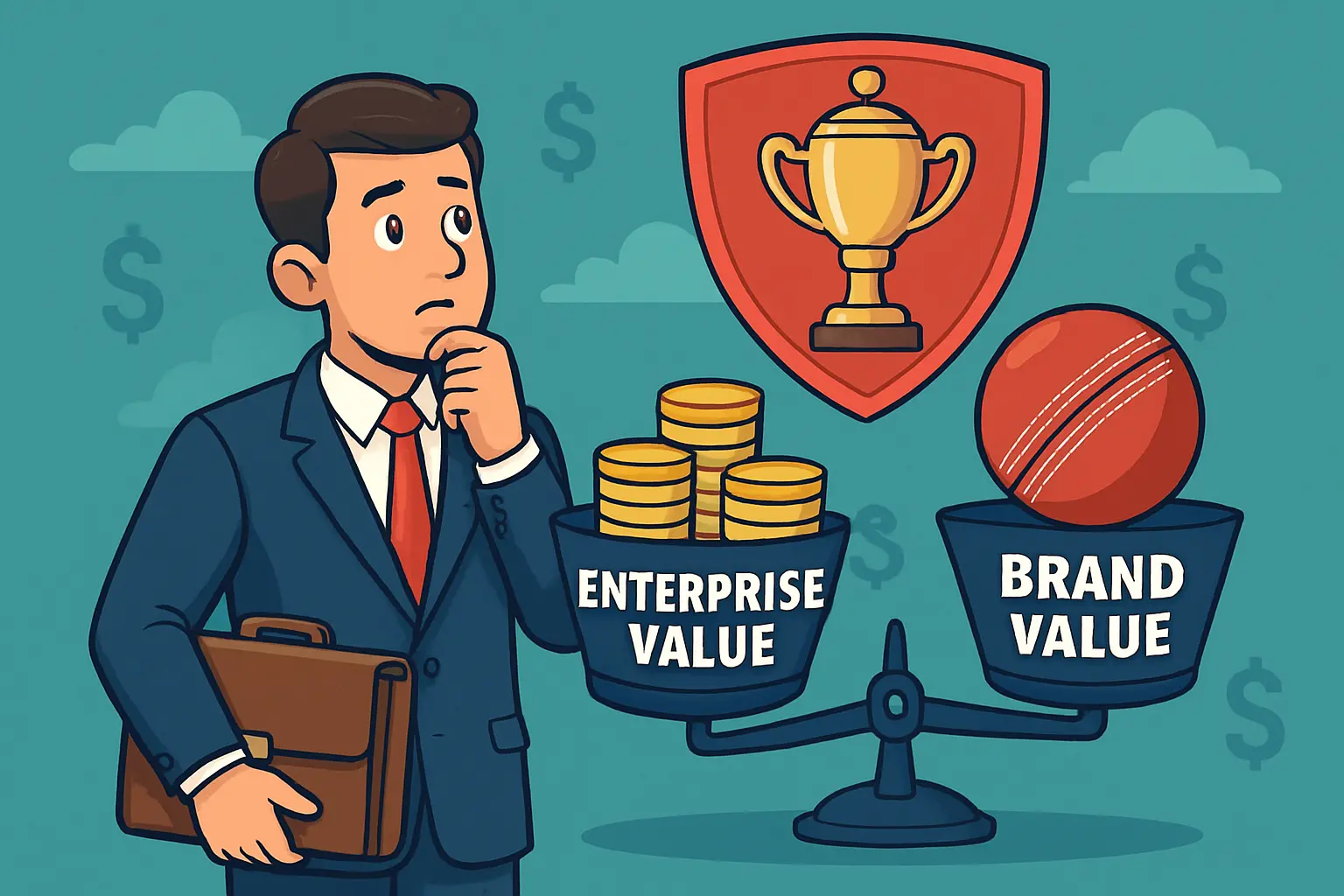
- Brand value: An estimate of how much the IPL’s brand—its name, logo, associated goodwill—contributes in economic benefits relative to a generic league. Brand Finance typically publishes this number using marketing-science tools. It’s narrower than what a buyer would pay to own the league.
- Enterprise value (EV): The value of the entire business, including the right to its current and future cash flows. For leagues, this is the figure closest to what people mean by net worth. It is influenced by media rights, sponsorship deals, match inventory, cost base, growth prospects, and risk.
- Revenue: Annual income. Great for understanding the engine, not the vehicle’s price tag.
- Market capitalization: Price of a publicly traded company; not directly applicable to the IPL entity as a whole, though some stakeholders are listed (e.g., broadcasters, some owners’ parent companies).
When someone asks, “What is the net worth of the IPL?” they usually want the EV-style answer: the value of the league as a going concern. That’s the framing used in this article.
Latest IPL valuation in rupees and dollars
You can triangulate the IPL’s value from several respected sources:
- D&P Advisory (previously Duff & Phelps in India) has built a long-running valuation series on the IPL, which pegs the ecosystem at roughly USD 11 billion. This is the figure that best maps to “IPL net worth” as a layperson would expect.
- Brand Finance publishes an IPL brand value that comes in lower, by design. It isolates the brand’s contribution rather than the whole business. For net worth intent, treat this as a complementary lens.
- Broadcast math supports the USD 11 billion range: the current media-rights cycle totals around INR 48,390 crore across TV and digital, with a per-match value just a shade below the NFL on a global per-game basis. When per-match media rights are that high and growing, EV follows.
- Team-level valuations confirm the premium: multiple independent lists place the top IPL teams near or above the USD 1 billion mark. If the franchises are that valuable, the league that underwrites them commands a multi‑billion premium.
Assumptions for currency: USD/INR ≈ 83. If the rupee strengthens or weakens, INR figures swing accordingly.
A quick view of “valuation lenses”
- Enterprise value (net worth intent): ~USD 11 billion (≈ INR 90,000+ crore)
- Brand value (marketing asset lens): substantially lower than EV by definition
- Annual revenue (steady-state season): driven by media rights (dominant), central sponsorships, licensing; dependable and growing
- Per-match media rights: ≈ INR 118 crore (≈ USD 14–15 million), one of the highest globally
Why the IPL is valued where it is
Four pillars prop up the IPL’s net worth:
- Media rights power: TV plus digital long-term contracts with incumbents who can monetize both ad-supported and subscription models at scale. The per-match rate is elite.
- National scale plus diaspora: Indian households treat the IPL as a seasonal festival. The Indian diaspora gives you late-night appointment viewing in the UK, Middle East, North America, and Oceania. You get prime-time in India and strong shoulder audiences overseas.
- Franchise stability and scarcity: Ten teams, no relegation. Scarcity supports high franchise fees and valuations. Predictable fixtures and home markets build habit.
- Commercial certainty: Central sponsorships, standardized inventory, strong compliance, and league-backed innovations (strategic time-outs, partner integrations) help brand partners plan ROI.
How the IPL makes money
Media rights dominate the IPL’s revenue pie. But the league and its franchises operate a multi-stream model.
- Domestic TV rights: The backbone of the media cash flow. Windowed primetime slots drive high cost-per-rating-point (CPRP) for advertisers.
- Domestic digital rights: Equally critical now. The digital holder leverages ad tech, free-to-view strategies, and deep sponsorship integrations to unlock reach—and a pipeline of paid products beyond the season.
- International rights: Sold territory by territory. Smaller in quantum than domestic, but meaningful as the diaspora grows and cricket’s T20 footprint expands.
- Central sponsorship: Title sponsor and central partners across categories like fintech, edtech, payments, beverages, and gaming. These partners buy visibility across every match, activation windows, and digital assets.
- Licensing and merchandising: Central licensing plus franchise lines. Smaller than media money, but rising with better merchandising supply chains.
- Matchday: Hospitality, on-ground activations, signage. Stadium deals vary by venue and team, but the inventory is now tightly managed and increasingly premium.
- Data and gaming: Partnerships with fantasy platforms and official data distributors. Data rights are a silent growth engine for most modern sports properties.
Within each team’s P&L, the mix looks like this
- Central pool share: A roughly half-share of the media-rights central pool flows to teams. Split equally, that means a typical franchise’s base revenue is anchored by a central check in the mid‑hundreds of crores per season.
- Local sponsorship: From front-of-jersey mega deals down to back-of-helmet, training kits, and community partners. Well-run teams can stack this to a nine-figure INR number.
- Ticketing and hospitality: Seven home games plus knockouts if qualified. Corporate boxes sell out quickly in traditional markets; general admission revenue depends on pricing strategy and stadium size.
- Merchandising: Still evolving, but the better brands have cracked quality and distribution, especially in metros and online.
- Prize money: Important psychologically; less material financially than media and sponsor flows.
Media rights breakdown and per-match economics
The current rights cycle was a watershed: for the first time, digital and TV were split between two heavyweight bidders, and a non-exclusive digital package created an extra slice of inventory.
- Total package value: about INR 48,390 crore across the full cycle.
- Domestic TV: the largest single package by rupees, held by the incumbent broadcast giant.
- Domestic digital: nearly as large, held by a deep-pocketed platform that runs the league with a mixture of free-to-view reach and targeted ad stacks, eventually cross-selling subscriptions.
- Non-exclusive high-value matches: a separate digital package covering marquee matches, designed to stretch the ecosystem and sharpen bidding.
- International rights: packaged separately across regions; modest but growing as cricket’s T20 audience globalizes.
- Per-match value: approximately INR 118 crore, or around USD 14–15 million.
What this means for a single match
Consider a typical night fixture:
- The broadcaster’s cost per match is pre-committed via the rights auction. Ad sales must exceed this cost plus production to create surplus.
- On TV, ad slots are sold both as packages and spot buys, with premium slots priced aggressively during powerplays, death overs, time-outs, and innings break.
- On digital, targeted ad tech—frequency caps, audience segments, and interactive formats—lets the rights holder push both brand campaigns and performance ads. Interactive formats like “watch & win” drive time spent and first-party data.
- The league and teams layer central and local partner assets around this inventory: signage, on-air mentions, AR graphics, and branded segments.
- Outcome: a robust per-match revenue stack that, when multiplied across the season, underwrites the elevated enterprise value.
IPL revenue sharing and the central pool
Exact splits evolve, but the broad logic is consistent:
- Media rights and central sponsorships are pooled centrally.
- A substantial share—roughly half—flows to franchises, typically split evenly. A small share is carved out for prize money and grassroots development.
- Teams then build local revenue on top of the central check and pay from their own cost base: salaries, staff, operations, venue, travel, marketing, and academy.
This system creates two things owners love: predictable cash flows and upside for good operators. If you run a tight ship and build a strong brand, your local sponsorship, ticketing, and merchandising scale. If you’re average, the central distribution keeps the lights on.
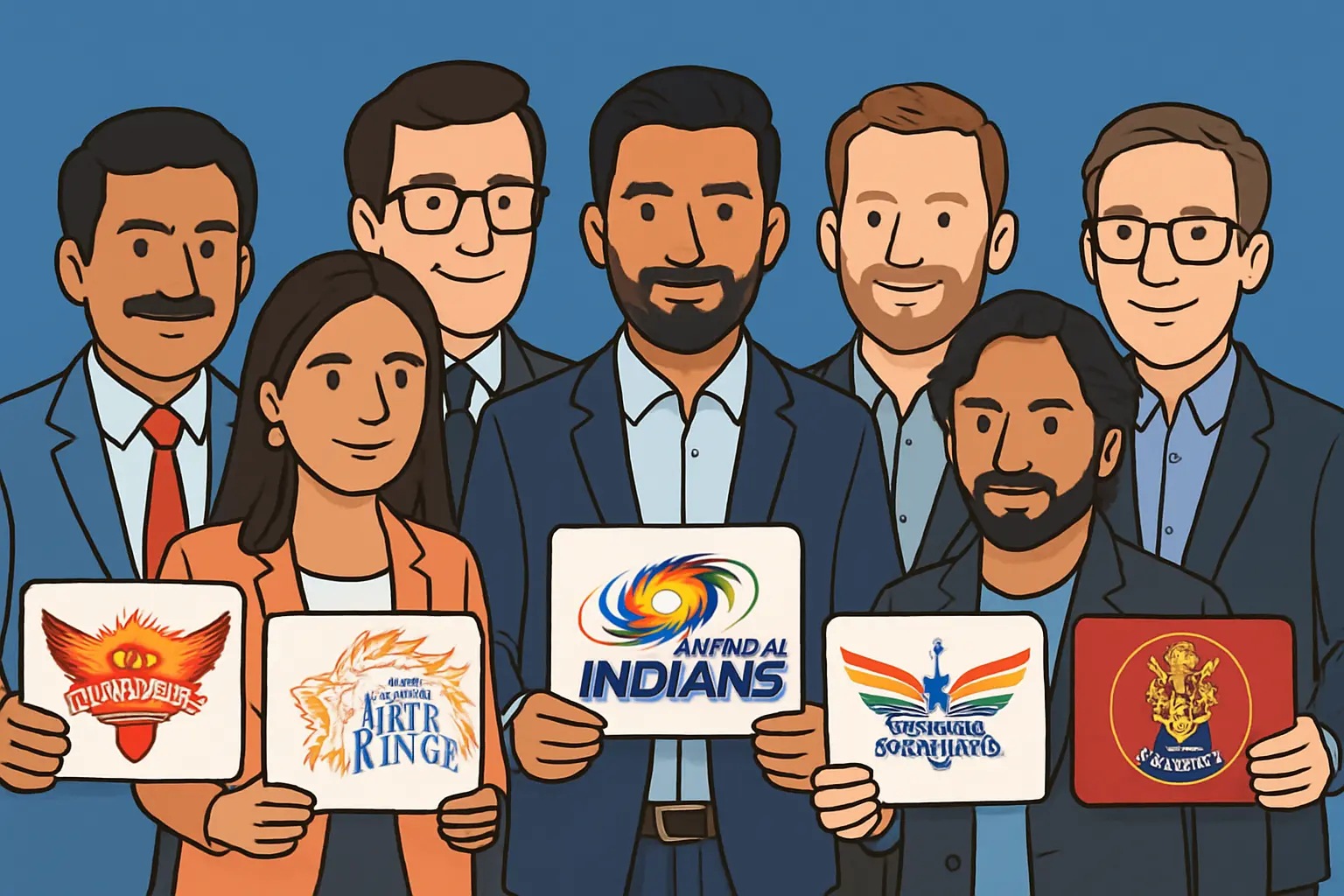
IPL team valuation ranking and owner snapshots
Independent estimates and transaction signals point to a clear hierarchy among franchises. The bands below reflect the latest credible ranges from media reports and valuation lists, expressed in USD and INR at USD/INR ≈ 83.
Table: IPL team valuation snapshot (est.)
| Team | Estimated valuation | Owner | Why it’s high |
|---|---|---|---|
| Mumbai Indians (MI) | USD 1.2–1.5 billion (INR 10,000–12,500 crore) | Reliance Industries (Indiawin Sports) | Five titles, massive market, deep sponsorship bench, global brand extensions (Cape Town, New York franchises). |
| Chennai Super Kings (CSK) | USD 1.1–1.3 billion (INR 9,000–11,000 crore) | Chennai Super Kings Cricket Ltd (promoted by The India Cements) | Religiously loyal fan base, consistent on-field success, powerful captaincy legacy, top-tier sponsor stickiness. |
| Kolkata Knight Riders (KKR) | USD 1.0–1.2 billion (INR 8,300–10,000 crore) | Knight Riders Sports (Shah Rukh Khan, Juhi Chawla–Jay Mehta) | Pop-culture halo, strong eastern markets, multi-club model (CPL link), robust digital reach. |
| Royal Challengers Bengaluru (RCB) | USD 1.0–1.2 billion (INR 8,300–10,000 crore) | Royal Challengers Sports (United Spirits) | Celebrity roster legacy, elite engagement metrics, metro-market spending power; sponsor magnet despite title droughts. |
| Lucknow Super Giants (LSG) | USD 0.95–1.1 billion (INR 7,900–9,100 crore) | RPSG Group | High entry fee, strong owner balance sheet, North Indian catchment. |
| Gujarat Titans (GT) | USD 0.9–1.05 billion (INR 7,500–8,700 crore) | CVC Capital Partners | Immediate on-field success, commercially savvy ownership, Western market strength. |
| Delhi Capitals (DC) | USD 0.9–1.1 billion (INR 7,500–9,000 crore) | JSW–GMR joint venture | Capital-city reach, strong corporate partner pipeline, deep youth pipeline. |
| Rajasthan Royals (RR) | USD 0.8–1.0 billion (INR 6,600–8,300 crore) | Emerging Media IPL; significant institutional investors | Early-bird brand equity, savvy digital commerce, high-development ethos. |
| Sunrisers Hyderabad (SRH) | USD 0.8–0.95 billion (INR 6,600–7,900 crore) | SUN Group | Southern heartland, media synergies with owner’s broadcast assets. |
| Punjab Kings (PBKS) | USD 0.75–0.9 billion (INR 6,200–7,500 crore) | KPH Dream Cricket (Mohit Burman, Ness Wadia, Preity Zinta, others) | Large statewide market, strong NRI base; upside if on-field consistency improves. |
These are not mere vanity numbers. Sponsorship quotes, merchandising sell-through, and international expansion opportunities all correlate with valuation. Front-of-shirt deals for the top four typically clear eight-figure USD territory when costed across cash plus deliverables.
A sample franchise P&L: how a season adds up
To understand how IPL valuation translates to the ground, here’s a stylized P&L for a mid-to-upper table team. Numbers are rounded ranges; actuals vary by market, stadium size, playoff run, and commercial skill.
Revenue
- Central media and sponsorship share: INR 450–550 crore
- Local sponsorship and partnerships: INR 120–200 crore
- Ticketing and hospitality: INR 35–80 crore
- Merchandising and licensing: INR 10–25 crore
- Prize money: INR 0–20 crore
- Total: INR 615–875 crore
Costs
- Player salaries (purse spend): INR 90–110 crore
- Coaching and performance staff: INR 15–30 crore
- Match operations and venue: INR 25–60 crore (permit fees, rentals, security)
- Travel, logistics, accommodation: INR 15–35 crore
- Marketing and fan engagement: INR 15–40 crore
- Admin and overheads: INR 10–25 crore
- Total: INR 170–300 crore
Operating result
- Operating profit: INR 315–705 crore
- Margin range: Very healthy at scale; late entrants with high financing costs and new-market investments are lower, but the central pool cushions.
These margins explain why franchise valuations have sprinted past the USD 1 billion threshold. A stable, media-first league with predictable seasonal profits is gold in sports finance.
Auctions, salaries, and player economics
The auction is the IPL’s drama engine and a not-so-subtle valuation lever. A few dynamics to keep in mind:
- The salary cap has climbed steadily. Teams don’t have to spend to the last rupee, but they almost always do.
- The most expensive IPL player ever now clears INR 24 crore for a single season. That number isn’t a symptom of recklessness; it’s the market absorbing the reality of swollen media money and the scarcity of true pace or elite death hitters.
- Flex slots and the impact player rule expanded tactical horizons. Owners ask their analysts for lineup flexibility and match-up dominance; that, in turn, increases the value of role-specific stars.
- Player value in franchise valuation: The superstar who adds five to seven wins above replacement in T20 is rare. Those wins can swing playoff revenue and multi-season sponsor renewals. For a team worth USD 1 billion, overpaying by INR 5 crore for a perfect-fit player is a rational bet.
- International calendars: The IPL’s clean window without international fixtures makes player commitment dependable. That certainty sustains high ad rates and, by extension, the league’s net worth.
Sponsorship gravity: title and central partners
The title sponsor deal sits in the low hundreds of crores per season and is the tip of a larger commercial iceberg. Central partners buy consistent exposure across:
- On-screen L-bands and bugs
- Strategic time-out branding
- Mid-innings shows and analytics segments
- Digital shoulder content and watch-along streams
- Trophy tour and opening ceremony rights
Because the IPL maintains premium-consistency delivery (full houses, peak GRPs, sticky digital session lengths), these deals renew at a premium, and new categories line up to enter. Fintech, edtech, consumer tech, beverages, automotive, gaming, and telecom have all found room.
Media rights value: why TV and digital both win
The IPL is one of the rare products where both TV and digital have credible, parallel win stories.
- TV wins on reach and habit. Family viewing, living-room setups, and the power of humming jingle-breaks remain unmatched. For advertisers with mass-reach KPIs—FMCG, auto, telecom—TV remains the safest bet at scale.
- Digital wins on interactivity and measurement. Watch parties, quick replays, multi-cam experimentation, micro-targeting, and the ability to attribute outcomes to exposure make the case for performance-led brands.
- The future is converged: “seconds” spent across screens will matter as much as “reach,” and the league’s net worth will be priced on time, not just people. The IPL is already there.
IPL net worth in rupees: why INR matters as much as USD
When you translate the IPL valuation into INR, you account for how the domestic market prices ad inventory, ticketing, and sponsorships. USD figures can make the league look smaller than it feels locally because cost bases and revenues are in INR.
- Net worth (EV lens): ≈ INR 90,000 crore
- Media rights per season: ≈ INR 9,600 crore (implied from cycle total)
- Per match media rights: ≈ INR 118 crore
- Top franchise valuation: > INR 10,000 crore
These are not vanity conversions. Sponsors write cheques in INR. Gate revenue reconciles in INR. Player salaries are paid in INR. Franchises manage FX exposures only for a slice of operational needs. Thinking in INR tells you what the league means for Indian enterprise.
Comparisons: IPL valuation vs other sports leagues
Different sports, different math. But a few fair observations help situate the IPL:
- Per-match media rights: The IPL sits second only to the NFL worldwide. That is staggering for a league that runs for two months and change. The scarcity of inventory in a compressed window boosts per-match intensity.
- Season length vs total rights: The NBA, EPL, and NFL run longer seasons with far more matches and, in total, larger rights packages. The IPL’s genius is concentration. It does not need marathon months to command premium pricing.
- Team valuations: Top IPL teams now nibble at NBA and MLB franchise valuations in the second quartile and comfortably exceed most soccer clubs outside the Premier League’s rich dozen.
- Other T20 leagues: PSL and BBL are excellent cricket products but operate at a fraction of the IPL’s commercial gravity. Per-match rights for these leagues are a sliver of the IPL’s; sponsor categories skew smaller; stadium and broadcast economics are more constrained.
- Richest cricket leagues: The IPL, by any fair business metric—net worth, media rights, average franchise value, or per-match revenue—is the richest cricket league on earth.
How IPL valuation grew: phases, not dates
You can tell the IPL’s financial story without a calendar by watching its phases:
- Launch and shock: The opening season rewired Indian prime-time. The idea that franchise cricket could be glam, loud, and technically elite—while still feeling local—proved out instantly. That early shock created brand value banks.
- Consolidation and credibility: Governance reforms, sharper financial controls, and hardened broadcast production standards built trust. Sponsors started thinking of the IPL as their “summer quarter” in a strategic plan.
- Digital awakening: As smartphones exploded, the IPL became the country’s social feed in motion. Clip culture, memes, and dual-screen habits lifted time spent and gave the league a second commercial engine.
- Ten-team equilibrium: Two new franchises validated the business model, drove up media-rights value, and created more home markets. Scarcity still holds, but diversity increased.
- Convergence era: TV and digital both mint money. Studios invest in data science and adtech. Teams incubate academies and content arms. The league is no longer a tournament; it’s a platform.
Owners, wealth, and influence
Owners matter in valuation conversations because balance sheets and networks change what’s possible. A few realities:
- Corporate giants (Reliance, JSW, RPSG, SUN Group) bring capital, media and retail synergies, and patience. They can fund long-term fan infrastructure—academies, content studios, loyalty programs—without sweating a single bad season.
- Celeb-led groups (KKR) bring cultural sizzle and global brand adjacency. In a league driven by fan affection, that aura converts.
- Institutional capital (CVC, other investors) brings discipline and global best practice. Multi-club operating models, talent pipelines, analytics sophistication—these are playbooks imported from Europe and the US.
- Legacy promoters (India Cements and affiliates) keep the league rooted in cricketing ecosystems outside the metros, which helps maintain depth in local markets.
Prize money, costs, and what it takes to run a team
Prize money is important theatre. The winner’s cheque sits around INR 20 crore, with the pool spreading across the top four. But teams optimize for season-long metrics, not just the podium: sponsor retention, digital growth, and ticketing health across seven home games.
Running an IPL team is operationally intense:
- Cap table: Equity alignment among owners and investors. New capital cycles are rare; teams prefer not to dilute given the strong cash base.
- Player personnel: Auction budgets, scouting networks, and data stacks that can value an uncapped domestic finisher as accurately as a global star.
- Commercial: Sponsor servicing is a religion, not a department. Teams that win here design content calendars and physical experiences that justify renewals before the first ball of the next season.
- Stadium partners: Contracts, revenue shares, and long-term upgrades. Owning or co-controlling venue inventory is a frontier that will separate the best-run clubs.
- Community: Fan clubs, junior leagues, school tie-ups. The next ten million fans are found, not assumed.
Brand value vs enterprise value: why the distinction matters
If you’re reading investor decks, you’ll see both numbers quoted.
- Brand value is useful when thinking about marketing efficiency: how much more will sponsors pay because it’s the IPL, and not a generic T20 league? That multiplier explains why title rights clear high hundreds of crores.
- Enterprise value is the number that would matter in a transaction: if a buyer could own the IPL’s economic rights, what would they pay? That calculus weighs media rights, growth trajectory, cost certainty, and legal structure.
Both figures can move in opposite directions short-term. A season with record viewership boosts brand value even if costs spike and compress margins. Conversely, locking a longer, richer media contract pumps EV even if brand cues hold steady.
BCCI revenue from the IPL: the flywheel effect
The BCCI is the central steward. The IPL’s media rights and sponsorships fund:
- Distributions to state associations
- Domestic cricket infrastructure
- Grassroots development
- National team operations and commercial programs
Because the IPL is profitable and growing, the BCCI has optionality. It can invest in broadcast innovations, youth pathways, women’s cricket, and international relations while maintaining a healthy surplus. Every incremental crore in IPL rights isn’t just a number on a spreadsheet; it’s a stadium upgrade, a better domestic tournament, a TV slot that carries a local hero into a million homes.
Women’s league implication
A related property has launched with strong ratings and sponsor interest. While it is early, the template is familiar: centralized media rights, a tight window, and a franchise model with cross-ownership by existing IPL teams. If it grows as expected, you will see portfolio effects: shared sponsors, bundled media inventory, and year-round fan engagement that benefits the IPL’s valuation indirectly by keeping cricket at the center of the national conversation.
Per-match revenue: TV vs digital vs on-ground
While the media-rights holder bears the heavy lifting, per-match revenue flows through multiple pipes:
- TV ad sales: premium inventory during powerplays, death overs, and strategic time-outs. Category clutter exists, but the IPL still sells scarcity (“that final over with two hitters on strike”).
- Digital ad sales: targeting, interactivity, branded content segments, watch-along communities. A sponsor can buy reach and precision at once.
- On-ground: LED boards, boundary ropes, dugout branding, hospitality lounges, and F&B tie-ins. These are shared between league and franchises based on pre-agreed contracts.
- Licensing and data: Fantasy integrations, official statistics, archive licensing. Quiet revenue, rising steadily.
Is the IPL the richest cricket league?
By any meaningful commercial measure—net worth (enterprise value), media-rights value, per-match pricing, average franchise valuation—the IPL ranks first in world cricket. The real competition for mindshare and money comes from global multi-sport giants. On that stage, the IPL already belongs in the top pack for per-match media value and continues to climb on team valuations.
How the media-rights math supports valuation
Analysts often back into valuations using a simple framework:
- Start with annual media-rights revenue
- Add central sponsorships and other central income
- Subtract league-level operating costs to get a steady-state operating profit
- Apply a multiple based on growth, risk, and comparables (top sports leagues trade at high teens to mid-twenties EV/EBITDA, depending on scarcity and growth)
- Stress test for macro risk: currency, regulatory, and tech disruption
The IPL clears each hurdle well. It has scarcity, dependable demand, and a structural audience tailwind as India adds households with higher disposable income and better bandwidth.
What could lift the IPL’s net worth next
- ARPU growth on digital: Turning mass free streaming into a hybrid model with micro-subscriptions for data-rich features without harming reach.
- International expansion: Not by moving matches out, but by scaling global content, localized feeds, and overseas academies.
- Better stadium economics: Renovations, more corporate inventory, and improved ingress/egress can push ticketing revenue higher without fan pain.
- Data monetization: Betting, fantasy, and programmatic ad stacks tied to first-party viewing data will juice non-traditional revenues.
- Calendar innovations: A sharper shoulder-content strategy (docu-series, academy coverage, mini-drafts) extends the monetization window.
Risks that could clip valuation
- Advertising cyclicality: A sharp macro downturn squeezes discretionary ad spend. The IPL is resilient, not invincible.
- Regulation: Changes in gaming, advertising, or competition rules could dent sponsor categories or viewership patterns.
- Talent pipeline shocks: If player availability suffers due to competing leagues or calendar conflicts, match quality could dip. The clean window has held; preserving it is critical.
- Fragmentation of attention: Competing entertainment formats and short-video platforms can leech minutes. The IPL has held its ground by making the broadcast feel like social media in motion.
FAQs: straight answers to the most searched queries
How much is the IPL worth today?
Approximately USD 11 billion in enterprise value, about INR 90,000 crore at USD/INR ≈ 83, based on independent valuations and rights math. For brand-value-only figures, expect a lower number by design.
Which is the richest IPL team?
Mumbai Indians and Chennai Super Kings typically lead, with valuations around or above USD 1 billion (INR 9,000–12,500 crore). Royal Challengers Bengaluru and Kolkata Knight Riders sit close behind.
What is the IPL media rights value?
The current cycle totals about INR 48,390 crore across TV, domestic digital, marquee digital, and international packages, implying roughly INR 118 crore per match.
How much do IPL teams earn per season?
A typical team’s revenue ranges roughly between INR 615–875 crore, depending on central share, local sponsorship strength, ticketing, and playoff outcomes.
How much does the BCCI earn from the IPL?
The BCCI retains a large share of central media and sponsorship income after franchise distributions and prize money. This makes the IPL the board’s biggest revenue engine, funding domestic cricket and infrastructure.
What is the per-match revenue of the IPL?
Media rights alone value a match at approximately INR 118 crore. Adding on-ground sponsorship, hospitality, and related streams pushes the per-match economic impact higher.
How is IPL valuation calculated?
Analysts triangulate media rights, sponsorships, match inventory, growth trajectory, and risk, then apply EV/EBITDA multiples used for premium sports properties. Brand value estimates use marketing-science approaches and serve a different purpose.
What is the IPL prize money?
The winner’s cheque sits around INR 20 crore; the total pool covers the top finishers. Sponsor bonuses from team partners can add performance-linked payouts.
What is the IPL team auction purse?
The salary cap per team sits a little above INR 100 crore. Teams almost always spend to the cap, balancing superstars with role players.
Who are the richest IPL owners?
Large industrial groups (Reliance via Indiawin Sports, RPSG, JSW, SUN) and financial sponsors (CVC) anchor the top. Celebrity-led groups like KKR add cultural heft and global brand value.
How do IPL teams make money?
The central pool (media and sponsorship distributions) is the anchor. Local sponsorships, ticketing, hospitality, merchandising, and prize money add layers. Some teams also monetize content and academies.
What is “IPL brand value vs net worth”?
Brand value measures the marketing power of the IPL name. Net worth (enterprise value) measures the entire business’s value based on its cash flows. For “how much is IPL worth,” use the enterprise value lens.
What is the business model behind IPL digital rights?
Free-to-view reach at scale with high ad loads, backed by interactivity and data, plus a ladder to premium paid features. The model can fund itself on advertising alone and upsell over time.
Is the IPL bigger than the PSL and BBL in value?
By media rights, franchise valuations, and per-match pricing, yes. The IPL operates at a multiple of the next T20 league’s commercial scale.
Do INR or USD figures matter more?
Think in INR for operational reality and sponsor spend; think in USD for global comparisons and capital-market context. The relationship between the two shifts with FX.
Sources and methodology
- Valuation anchors: D&P Advisory ecosystem valuation; Brand Finance brand valuation. These provide complementary lenses—enterprise and brand.
- Rights and revenue math: BCCI announcements and tender documents; rights-holder disclosures; major business media’s reporting on package splits and per-match values.
- Team valuation ranges: Forbes lists, financial press, ownership disclosures, and transaction signals; refined by sponsor deal chatter and market scuttlebutt.
- Currency: USD/INR ≈ 83 assumed for conversions.
As a finance-first observer who also spends time in the broadcast compound and sponsor suites, I’ve learned to trust what the numbers say and what the room feels. The room around the IPL has the rare hum of inevitability—brands that must be there, fans who will show up, and owners who now think in decades. That hum is what valuation models are trying to capture.
Conclusion: why the IPL’s net worth will keep compounding
Value in sports is not just data. It’s ritual, reach, and reliability. The IPL has all three. It owns a season in the calendar. It reaches hundreds of millions on two screens at once. It delivers without fail: crisp production, full houses, a parade of heroes. That’s why its net worth sits around USD 11 billion and why the curve still points up.
Media rights will keep inflating as digital monetization deepens. Teams will push into community, content, and academies, widening their revenue base. Stadiums will get smarter. Data rights will quietly balloon. And every summer, the country will still stop for those last three overs when anything can happen. That is not a fad. That is a franchise. And franchises compound.